
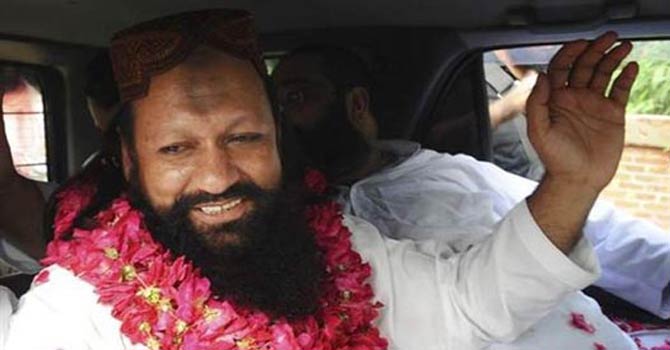
Once more Justice has been denied in Pakistan after a mass murderer Chief of Lashkar-e-Jhagvi, ‘Malik Ishaq’ released by anti-terrorist court, Rawalpinidi on Thursday, in three cases relating to terrorism, The Shia Post reported
Judge Rana Masood Akhtar issued acquittal orders for Ishaq in the cases, saying the evidence against Ishaq was not sufficient for further proceedings.
The had been registered against Ishaq at police stations in Attock, Hazro and Talagang and he was also previously arrested over charges relating hate-speech and inciting violence.
Having faced charges relating to killing of 1000s Pakistani people, most of them Shia Muslims, and the attack on the Sri Lankan cricket team in March 2009, Ishaq has spent around 15 years in Pakistani jails.
Terrorist Malik Ishaq is a Pakistani militant leader involved in sectarian violence against the Shia community in Pakistan. In 1996, Ishaq, along with terrorist Akram Lahori a.k.a. Muhammad Ajmal and terrorist Riaz Basra was a founder of the Deobandi Sunni militant organization Lashkar-e-Jhangvi.
Terrorist Malik Ishaq was born at Taranda Sawaey Khan in Rahim Yar Khan district of Punjab, Pakistan. His father Ali Ahmad Awan was a cloth merchant.
Lashkar-e-Jhangvi was formed when Sipah-e-Sahaba (SSP) activist Riaz Basra broke away from the SSP over differences with his seniors. The group is considered a terrorist organisation by Pakistan and the United States, and continues to be involved in attacks on Shi’a civilians and protectors of them. Lashkar-e-Jhangvi is predominantly Punjabi. The group has been labelled by intelligence officials in Pakistan as a major security threat.
Riaz Basra gained notoriety when he orchestrated the assassination of Iranian diplomat Sadiq Ganji in Lahore. Basra was also involved in the killing of Iranian Air Force cadets visiting Pakistan in the early 1990s, when sectarian attacks on Shias in Pakistan were at their peak.
LJ has ties to the Taliban, the Islamic Movement of Uzbekistan (IMU), Sipah-e-Sahaba (SSP), Harkat-ul-Mujahideen (HuM), Jaish-e-Mohammed (JeM), al-Qaeda, and Jundallah. In addition to receiving sanctuary from the Taliban in Afghanistan for their activity in Pakistan, LJ members fought alongside Taliban fighters.
Pakistani government investigations in 2002 revealed that Al Qaeda has been involved with training of LJ, and that LJ fighters also fought alongside the Taliban against the Afghan Northern Alliance. The Pakistan Interior Minister, speaking of LeJ members, stated: “They have been sleeping and eating together, receiving training together, and fighting against the Northern Alliance together in Afghanistan.”
Upon the death of Riaz Basra in May 2002, correspondence between al-Qaeda and LJ seems to have stopped. Basra communicated to al-Qaeda commanders through Harkat ul-Ansar
/129



